
How to Eat High-Protein as a Vegan
Protein is a hot topic in the wellness space, and with good reason. Protein is important for keeping our bodies strong — including our bones, muscles, connective tissue, and skin. There are countless types of proteins in our bodies and they perform many different functions in addition to strength and structure, such as cell signaling, gene transcription, facilitating chemical reactions, transporting molecules, immunity, and more. There is no doubt that eating and maintaining enough protein is essential for health.
While protein is important, that doesn’t mean we need to obsess over it or make it the entire focus of our diets. Some of us eat plenty of protein while others could benefit from eating more protein.
Since vegan diets do not include stereotypical high-protein foods such as meat, fish, dairy and eggs, it’s common to wonder if it’s possible to eat a high-protein vegan diet.
The answer is yes. Yes, you can be a high-protein vegan. Do you need to be a high-protein vegan? That depends.
If you haven’t read my Plant-Based Protein 101 post, start there!
How Much Protein Do I Actually Need?
Protein requirements depend on a variety of factors, including age, body size, activity level, lifestage, disease state, injuries, and more.
As for the number crunching, below are the recommendations from a variety of sources.
I won’t bore you with a deep dive into why there are so many different recommendations, but rather share them here and help you see that there isn’t one clear answer to the question of individual protein needs.
I’m also providing some basic example calculations below and chose very easy numbers to work with. These numbers do not indicate what anyone should weigh or how many calories they should eat.
- The Recommended Dietary Allowance (RDA – the amount set by the Food and Nutrition Board of the Institute of Medicine as an average daily amount most people need) for protein is 0.8 grams per kilogram of body weight. Many people consider this a minimum amount of protein needed to prevent health issues. By this thinking, someone who weighs 150 pounds needs a minimum of 55 grams of protein per day.
- The Acceptable Macronutrient Distribution Range (AMDR – the range set by the Food and Nutrition Board of the Institute of Medicine to help prevent chronic disease) for protein is 10% to 35% of daily calories. Some people consider this approach unhelpful, but I’m sharing it nonetheless. By this thinking, someone who eats 2000 calories per day needs to eat 50 to 175 grams of protein daily.
- The National Resource Center on Nutrition and Aging recommends 1.0 to 1.2 grams of protein per kilogram of body weight for older adults. By this thinking, someone who is older than 65 and weighs 150 pounds needs to eat 68 to 82 grams of protein per day.
- The American College of Sports Medicine recommends 1.2 to 2.0 grams of protein per kilogram of body weight for athletes. This is a large range with a quite high upper limit that involves many factors, and the upper range is usually only advised temporarily in certain situations. By this thinking, a 150 pound athlete needs to consume 82 to 137 grams of protein per day.
- Some researchers and experts recommend an even higher range for athletes, such as 1.6 to 2.2 grams of protein per kilogram of body weight.
As you can see, there’s a large gap between what the average person needs to maintain health (0.8 g/kg/day) and what some experts say an athlete may need for optimal training and performance (up to 2.2 g/kg/day).
You might be thinking, “OK, I’m not an athlete but I work out regularly and want to build muscle. How much protein do I need? Certainly more than the minimum, but not as much as an elite athlete.”
As for how much you need, you can consider the above factors, as well as how you feel in your body. Also know that there are flaws in calculating nutrient needs based on body weight. A registered dietitian can help you explore how much protein keeps you feeling your best and supports your athletic goals.
Do I Need to Count Grams of Protein?
As a registered dietitian, I believe that most people do not need to count grams of protein.
So what do you do instead? Continue reading to learn what types and amounts of vegan foods are high in protein. Get used to incorporating high-protein vegan foods, in ample portion sizes, into your daily meals and snacks and rest assured you’re eating plenty of protein.
If you have questions or concerns about your protein intake, an RD is here to help!
I do not recommend number crunching or measuring your food if you have a history of disordered eating as this can be a slippery slope. Instead, work with an RD who specializes in disordered eating – they can help you meet your nutrient needs without focusing on numbers.
Is It Hard to Eat a High-Protein Vegan Diet?
While it’s possible to eat a high-protein vegan diet, that doesn’t mean it’s easy. Especially if you’re not already used to eating balanced meals or high-protein vegan foods.
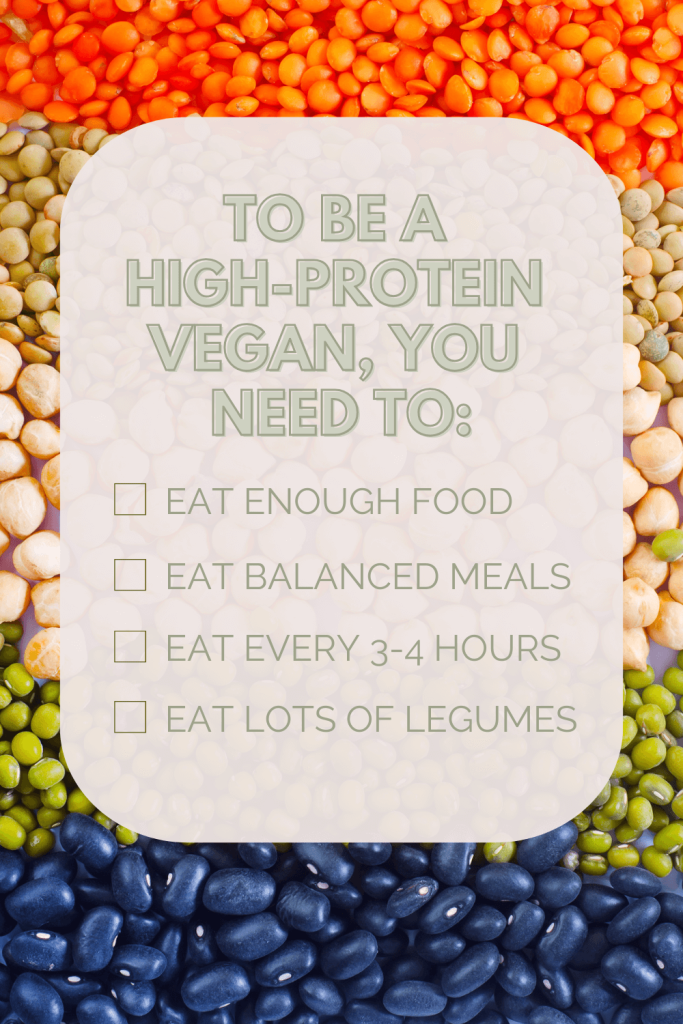
If you’re eating balanced meals throughout the day and regularly incorporating legumes, seitan and vegan meats, you might already be eating relatively high-protein.
There are two critical strategies to consider when it comes to protein.
The first is eating enough. When you’re undereating, your body is forced to use some of the protein you eat for fuel rather than for all of the other important functions (including muscle synthesis). And of course, when you lose weight, part of that is muscle.
The second is eating balanced meals at consistent intervals throughout the day. If you could only take one piece of information from this article, this should be it. This single strategy will have the greatest impact on your nutrition. This is where I spend a lot of time with my clients. Not only is it essential, but it can also be challenging to implement if you don’t already make nutrition a priority. This is where many people need a lot of support.
How to Eat to Build Muscle as a Vegan
Why are consistent, balanced meals important when it comes to protein?
Firstly, the overall amount of protein in a day isn’t what matters most. Our bodies prefer nutrition to be spread throughout the day, including protein.
We need to eat a certain amount of protein in a sitting in order to stimulate muscle protein synthesis. Values range but settle around 20 grams of protein. Ideally we’re eating this amount a few times a day to stimulate consistent muscle growth.
This is why the ACSM recommends 15 to 25 grams of protein within 2 hours of a workout, and 0.3 grams of protein per kilogram of body weight (20 grams protein for a 150 pound person) every 3 to 5 hours during the day.
This isn’t new information! Eating at regular intervals is a core strategy of good nutrition in general, not just when it comes to protein and muscle growth.
What Does a High-Protein Vegan Diet Look Like?
Here’s a simplified example with easy numbers: If your overall goal is to eat around 100 grams of protein per day, you can achieve that by eating about 25 grams of protein at 4 different eating occasions. Or roughly 20 grams of protein at 5 different eating occasions.
That could look like:
- 7am breakfast with 25 grams of protein
- 10am snack with 15 grams of protein
- 1pm lunch with 25 grams of protein
- 5pm dinner with 25 grams of protein
- 8pm snack with 10 grams of protein
Want to get more specific? OK, I’ll show you! Here are examples of very simple high-protein meals and snacks.
I am not including every single food or ingredient but showing you the general components of the meal with special attention on the protein-rich foods. Nutrient information sourced from the USDA’s FoodData Central database and food labels.
Each meal and snack may contain a handful more grams of protein from the small amounts that add up from fruits and vegetables.
High-Protein Vegan Breakfasts
Tofu scramble made with ½ block tofu (20 grams protein), 1 cup vegetables and 2 pieces sprouted-grain toast (8 grams protein) with ½ avocado = 28 grams protein
Oatmeal made with ½ cup quick oats (5 grams protein), 1 cup soy milk (7 grams protein), 2 tablespoons peanut butter (8 grams protein), 1 tablespoon chia seeds (3 grams protein), 1 tablespoon pumpkin seeds (2 grams protein) and 1 cup of fruit = 25 grams protein
Smoothie made with 1 cup soy milk (7 grams protein), 1 serving pea protein powder (15 grams protein), 1 tablespoon peanut butter (4 grams protein), 1 banana, 1 cup greens = 26 grams protein
High-Protein Vegan Lunches
Sandwich with 2 pieces whole-wheat sandwich bread (6 grams protein), 5 soy deli slices (14 grams protein), vegan cheese, lettuce, mayo, and mustard; 1 cup raw vegetables with ¼ cup hummus (4 grams protein); 1 piece fruit = 24 grams protein
1 can lentil soup (16 grams protein); 2 pieces sprouted-grain toast (8 grams protein) with ½ avocado, 1 cup fruit = 24 grams protein
Bowl with 1 cup cooked white rice (4 grams protein), ½ block cooked tofu (20 grams protein), 1 cup mixed vegetables, sauce made with 2 tablespoons peanut butter (8 grams protein) = 32 grams protein
High-Protein Vegan Dinners
Bowl with 1 cup cooked quinoa (8 grams protein), 1 cup cooked lentils (18 grams protein), 1 cup broccoli, sauce made with 2 tablespoons tahini (5 grams protein) = 31 grams protein
Stir-fry with 1 cup cooked brown rice (4 grams protein), 1 cup cooked tempeh (33 grams protein), 1 cup mixed vegetables = 37 grams protein
1 cup cooked whole-wheat pasta (5 grams protein), 3 ounces seitan (27 grams protein), ½ cup marinara sauce, 1 cup cooked kale = 32 grams protein
High-Protein Vegan Snacks
Protein bars are great in a pinch, but they can get pricey and boring, and may contain ingredients some people prefer to avoid. Here are some tasty and varied vegan snack ideas that pack protein from legumes, nuts, seeds, grains and seitan.
1 cup soy yogurt (9 grams protein), 2 tablespoons chia seeds (6 grams protein), ½ cup chopped fruit = 15 grams protein
2 seitan deli slices (11 grams protein), 1 ounce whole-wheat crackers (3 grams protein), ½ cup cherry tomatoes = 14 grams protein
½ cup hummus (8 grams protein), 1 whole-wheat pita (6 grams protein), 1 cup raw vegetables = 14 grams protein
⅓ cup roasted edamame (14 grams protein), 1 cup fruit = 14 grams protein
Sandwich with 2 pieces whole-wheat sandwich bread (6 grams protein), 2 tablespoons peanut butter (8 grams protein), 1 tablespoon jam = 14 grams protein
¼ cup roasted peanuts (9 grams protein), 2 tablespoons pumpkin seeds (4 grams protein), ¼ cup dried fruit = 13 grams protein
1 ounce roasted chickpeas (6 grams protein), 1 ounce soy jerky (5 grams protein), 1 cup fruit = 11 grams protein
Ways to Add More Protein to Vegan Food
If you review the example meals above, can you see a strategy that drastically impacts the protein content?
Eating hearty servings of legumes or seitan at every meal.
That single strategy will take you far when it comes to protein. Additionally, incorporating full helpings of grains, even refined grains, boosts the protein content of a meal.
Here are some additional tips to add more protein to vegan meals and snacks:
- Use nuts and seeds as garnish
- Blend beans into soup
- Add red lentils into pasta sauce
- Add canned beans or lentils to salads
- Use soy or pea milk
- Choose legume pasta
- Use silken tofu in creamy recipes
Is Soy Safe to Eat Daily?
A quick word on soy since this is a common question and area of misinformation.
Let’s set the record straight: Soy is safe to eat (unless you’re allergic to it, of course) and is one of the most well-researched foods on the planet.
Not only is soy safe, but it’s associated with health benefits such as lowering the risk of heart disease. It delivers protein, fiber, choline, and heart-healthy fats, among other nutrients. And, it’s way more gentle on the planet than animal proteins. If you’d like to take a deep dive into the science of soy, VeganHealth has a great summary of the evidence.
Soy is exceptionally helpful for eating high-protein as a vegan. Tofu is a versatile staple that can be enjoyed in myriad ways, while tempeh, soy milk, soy yogurt, and soy-based meats add even more variety and satisfaction.
What is Seitan?
Seitan (phonetically: say-tan), nick-named wheat meat, is a meaty food made from wheat gluten. It has a centuries-long history in East Asia. If you have celiac disease, do not eat seitan.
Gluten is a protein found in wheat, rye, and barley, thus why seitan is so high in protein.
It can be made by “washing” wheat flour until all that is left is the gluten. Or, you can buy vital wheat gluten and use that to make it. You don’t have to make seitan from scratch, though.
There are a variety of seitan products available at grocery stores, usually a mixture of national and local brands. You can buy it plain or spiced up in a variety of flavors, such as Italian-style, chorizo-style, pepperoni-style, and more.
You can even order it online from places like Herbivorous Butcher (their ribs and pastrami are incredible).
Do You Need Protein Powder as a Vegan?
You can see from the example meals and snacks above that you don’t have to use protein powder to eat high-protein as a vegan. You can easily reach 100 grams of protein from vegan foods.
While protein powder isn’t necessary, it is convenient.
I personally love a hearty breakfast smoothie with chocolate pea protein powder, peanut butter, banana, frozen berries, greens and almond milk. It’s a very easy breakfast that I can sip while helping my kids in the morning.
Protein powder is helpful for busy days, athletes with very high protein needs, and people who struggle with low appetites or undernutrition.
The Highest Protein Vegan Foods
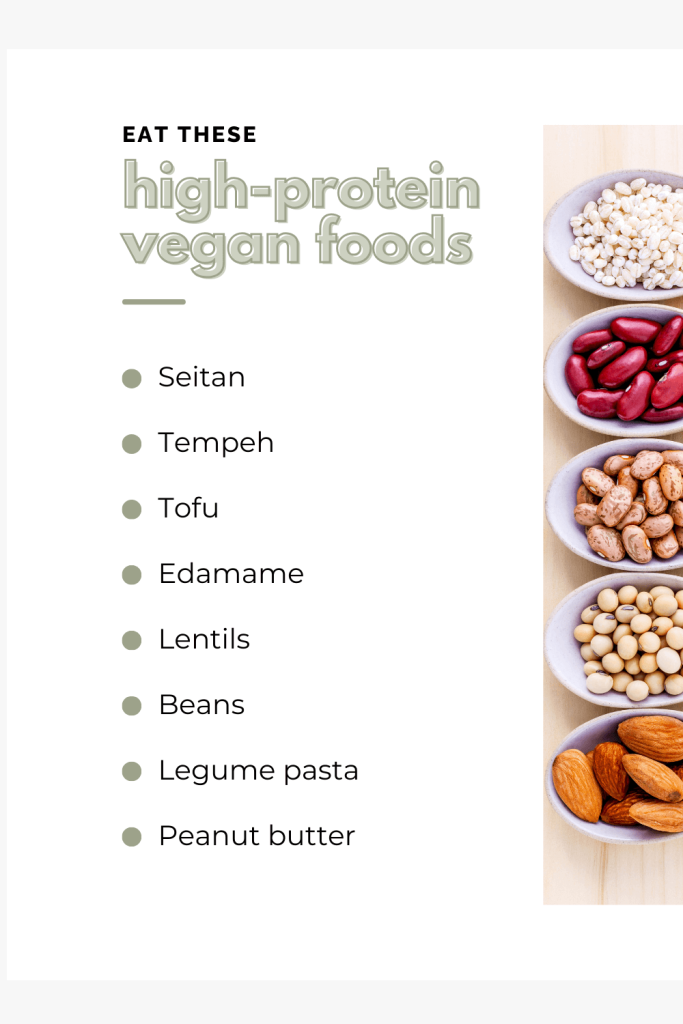
To review, legumes and seitan pack the most plant-based protein.
On the spectrum of high-protein vegan foods, whole legumes and tofu are at the lower end, tempeh and soy- and pea protein-based meats are in the middle, and seitan is at the higher end.
I’m including serving sizes that are considered a customary “serving” of these foods (½ cup cooked legumes, 3 ounces for the meaty items, 2 tablespoons peanut butter, ¼ cup peanuts) but you may choose to eat more or less. I personally find 3 ounces of tofu (⅕ of a block) to be a rather small serving, while 3 ounces of seitan is very filling to me.
- 3 oz seitan = 27 grams protein
- 1 seitan sausage = 25 grams protein
- 3 oz tempeh = 18 grams protein
- 3 oz Daring Original Plant Chicken (soy protein) = 17 grams protein
- 1 Beyond Brat (pea protein) = 17 grams protein
- 3 oz Beyond Beef Plant-Based Ground (pea protein) = 16 grams protein
- 2 oz red lentil pasta = 14 grams protein
- 3 oz Impossible Italian Meatballs (soy protein) = 12 grams protein
- 2 oz chickpea pasta = 11 grams protein
- 3 oz extra-firm tofu = 9 grams protein
- ½ cup cooked lentils = 9 grams protein
- ½ cup shelled edamame = 9 grams protein
- ¼ cup roasted peanuts = 9 grams protein
- 1 cup soy milk = 8 grams protein
- 2 tablespoons peanut butter = 8 grams protein
Not Everyone Needs to Eat High-Protein, But Vegans Can Eat High-Protein if They Want
Now you have the facts on vegan protein and know that you can definitely eat 100 grams of protein or more as a vegan, even without the help of protein powder!
Need some help figuring out how much protein you need, how to incorporate plenty of protein into meals and snacks, or how to make balanced meals fit into a busy lifestyle? I’m here to help.
What questions do you have about vegan protein? Drop them in the comments!

Hi there!
I'm Taylor
Registered dietitian and Certified Befriending Your Body Teacher.
I specialize in disordered eating recovery, body image, and vegan nutrition.
I specialize in disordered eating recovery, body image, and vegan nutrition.
Recent posts

Previous Post
10 Easy Vegan Dinner Ideas (no recipes needed)
Next Post